 Päivän sana
  Päivän pyhät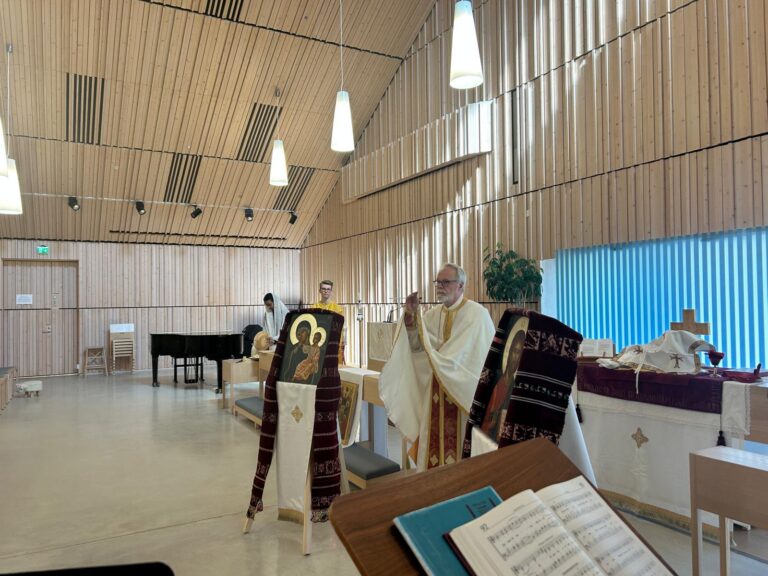
Foto: Leena Mikkilä-Huttunen


Gospel Reading for the Feast
Mark 15:43–16:8
Joseph of Arimathea, a respected member of the council, who was himself waiting for the Kingdom of God, went boldly to Pilate and asked for the body of Jesus.
Pilate was surprised to hear that He was already dead. Summoning the centurion, he asked him whether He had been dead for some time.
And when he learned it from the centurion, he granted the body to Joseph.
Then Joseph bought a linen shroud, took Him down, wrapped Him in the linen, and laid Him in a tomb that had been hewn out of the rock; and he rolled a stone against the entrance of the tomb.
Mary Magdalene and Mary the mother of Joses saw where He was laid.
When the Sabbath was past, Mary Magdalene, Mary the mother of James, and Salome bought spices, so that they might go and anoint Him.
And very early on the first day of the week, they came to the tomb when the sun had risen.
And they were saying to one another, “Who will roll away the stone for us from the entrance of the tomb?”
But when they looked up, they saw that the stone had been rolled away, although it was very large.
And entering the tomb, they saw a young man sitting on the right side, clothed in a white robe; and they were struck with amazement.
But he said to them, “Do not be afraid. You seek Jesus of Nazareth, who was crucified. He is risen; He is not here. See the place where they laid Him.
But go, tell His disciples and Peter that He is going before you into Galilee; there you will see Him, just as He told you.”
And they went out and fled from the tomb, for trembling and astonishment had seized them. And they said nothing to anyone, for they were afraid.
Christ is Risen!
Holy Pascha is for us Orthodox Christians the happiest day of the year, and it should be
so! The celebration of Pascha, during easter night, and the following festal season until
Pentecost, fills us with joy and light, and gives us energy of hope and optimism for the rest
of the year.
Today, the third Sunday of Pascha, of the Holy Myrrhbearers, equal-to-the-Apostles, we
return to the core of the Paschal experience, the unexpected joy, “nechaennaia Radost”.
But is Pascha and Paschal joy something separate from our daily life? Is it an escape from
the world, a fairy-tale or a dream that gives us a break from the harsh realities of this world
and this time? Was V.I Lenin right when he spoke of religion as “an opium of the people”,
as an intoxicant that helps us to bear unbearable life in an unjust world?
We can best realise and assume (internalise) Paschal joy, if we see it as a whole, together
with its long preparatory season. In fact, Pascha enlightens all the first half of the year. Six
weeks of Great Lent, with three preparatory weeks before, Holy Week, and the Paschal
period of 50 days, and 8 days of Pentecost – all this forms a totality of 16 weeks, or 4
months. This year, in the new calendar, from 25 January to 31 May. This is a most
wonderful treasure of the Orthodox Tradition, and we can discover it anew ever spring, and
draw from it new wisdom, consolation and joy the whole year.
The long preparation to Pascha is culminated during Holy Week. We follow the last week
of Jesus Christ on earth from day to day, from hour to hour. We encounter the deepest
questions and tragedies of human life during these days: betrayal, unjust condemnation,
abandonment, torture and death, as well as the fear of the disciples and the sorrow of the
mother. The fate of Christ in the hands of humans reflects the deepest abyss of sin and
tragedy – until death. During Holy Week we think of this inexorable trail of death, and
together with it we remember all the hopeless suffering people inflict on each other through
injustice, violence, war and murder.
We understand that the first Holy Friday and Holy Saturday were not days of hopeful
reverence and expectation for the disciples and the Mother of Jesus. It was a catastrophe!
They had not really understood who this Jesus was. They realized little by little that He
was the anointed one of God – but they had not realised what kind of Kingdom he was
talking about. Some of them hoped it would be a political Kingdom, a State of Israel… But
with his arrest and condemnation, crucifixion and death everything all these hopes were
shattered. The disciples had left everything and followed Jesus for three years. Now they
had lost their teacher, their guide, and all meaning of life. They were devastated, horrified
and afraid. They fled, they left their Teacher and Lord to die alone. Only His Mother, the
youngest apostle and some of the women had the courage to face the cross and death of
Jesus Christ. But all was darkness and hopelessness.
It is into this abyss of fear and despair that the light of the Resurrection shines. Salvation
does not remove us from this world, but brings hope and light into the very reality of ours,
into all of its deepest and darkest corners. In all four Gospels, we can feel the surprise, the
unexpected joy (nechaennaia Radost) of the empty tomb, the surprise and excitement of
the Holy Myrrhbearers – 2000 years ago.
A trail of joy starts at the empty tomb. In the same way as the inexorable trail of death had
led the events to the cross and to the despair and abandonment at the death and tomb of
Jesus, another trail is opened through the light that shines directly from the exhilarating
surprise of the empty tomb. This light gives the frightened disciples new insight, new faith
and hope – a new life. With this joy, they go to all the world to bring the gospel – that life
reigns over death, that the power of evil and violence has been overcome, death has been
trampled down by the Lord’s death.
This is the joy of Pascha, the reason for our celebration and our hope. We live in this
world, amidst all the uncertainties, injustices, tragedies, in the darkness of the shadow of
death. All the way to us, the unexpected joy comes to, us Pascha comes to us,
Resurrection and life comes to us.
Archpriest Heikki Huttunen
Sunday of the Holy Myrrhbearers,
Sunday 19 April 2026
Suvelan evl kappeli, Espoo Centre
The community of the Holy Myrrhbearers gathers for the Divine Liturgy at the Suvela Evangelical Lutheran Chapel once a month. The community was founded in 1999, when the social project Trapesa had its own Orthodox chapel in Espoo Centre. Three years ago, the funding ended, and the community lost its home base. Thanks to the hospitality of the Lutheran Church, this multicultural Orthodox community has been able to continue its life.